
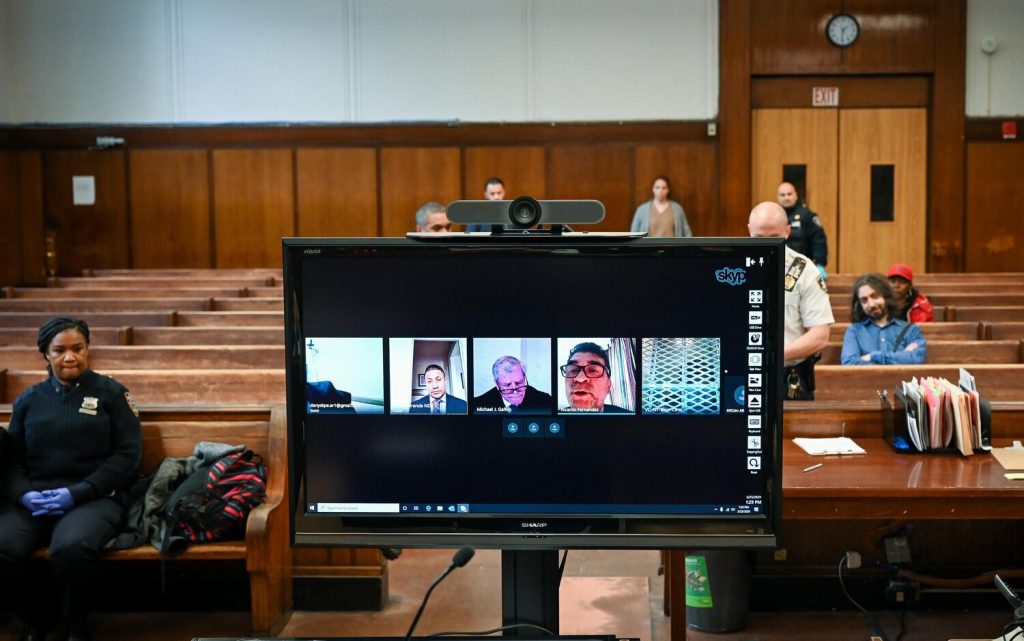
The discussions on the proposed amendments to the rules by the judiciary to facilitate proceedings via remote communication technology has raised this question – Is it possible to have an effective and fair trial by way of video conferencing?
The answer was given in Nottingham, England on 27.3.2020.
First, the facts. By March 2020, Covid-19 had been unleashed. Public safety precautions had been put in place including social distancing. A case came up for trial for three days on 17.3.2020 before the Court of Protection at Nottingham. It was literally a matter of life and death. A man in his seventies has been receiving hydration and nutrition through feeding tube since suffering a major stroke in 2016. His daughter was convinced that he would not want to continue living in such a state as he had expressed a wish that he would rather die than be kept alive as a ‘body in a bed’. She asked the doctors to withdraw the feeding tube believing that to be her father’s wish, against her own wish. The doctors disagreed as medically he was still capable of enjoying certain aspects of his life. The matter was referred to the Court of Protection. The judge was Justice Mostyn.
All parties agreed that the matter was important enough not to be adjourned but the outbreak of Covid-19 meant that a conventional courtroom trial was unacceptable due to the health risk to the participants. An alternative solution had to be found. With less than 24 hours before the trial, on the suggestion of one of the solicitors, the Court agreed to conduct the trial by way of video conferencing using the platform Skype for Business. This was going to be the first trial in England and Wales to be held entirely by way of video conferencing. The press was informed and reporters were invited to attend, via remote means, of course.
The trial went on as scheduled for three days. The judge, solicitors, parties and witnesses used lap top from their respective home and office throughout England. There were five sets of solicitors. Eleven witnesses including three expert witnesses gave evidence. Two journalists attended to report on the proceedings. Justice Mostyn had to decide the dreaded question – whether the feeding and treatment tube should be withdrawn to allow the man to be set on the path leading to inevitable death.
On 27.3.2020 Justice Mostyn delivered the decision. On the pioneering video conference trial, he was impressed and set the tone for the future when he said – “The trial went on almost without a hitch” and “In the current national crisis, it must be expected that hearings will be conducted remotely in this way as a matter of routine practice.”
Why is this case of importance?
Not only because it was the first full blown trial by video conference; but more because of the various aspects of the proceedings itself – that lawyers would usually be concerned with when it comes to ensuring a fair and effective trial . There was a sense of urgency in the matter. The subject matter was important enough – a matter of life and death. There were multiple parties and a battery of solicitors involved. It was a lengthy trial. There were multiple witnesses. There was expert evidence to be examined – not one but three experts. The facts were complex with scientific data. There was heavy documentation with a total of 929 pages of evidence and witness statements all produced via electronic files. The parties were geographically located at various corners of England. The decision to go by way of video conference was made on the eve of the proceedings with less than 24 hours notice and yet the technical challenges were met and resolved. Access to public was also made possible by having reporters present to report on the proceedings.
So, is it possible to have an effective and fair trial by way of video conferencing?
This case is a good reliable evidence to suggest a strong ‘yes’. The idea of trial by way of video conferencing or other proceedings by way of electronic means should be warmly welcomed and embraced by lawyers here – provided of course that the necessary legal and regulatory footing must be put in place first. Whilst conventional courtroom hearing is still the gold standard and the preferred choice, hearing via electronic means should be accepted as a reliable alternative along with conventional hearing.
Oh yes, so what was the decision in that quantum leap trial?
Sitting remotely, on 27.3.2020, Justice Mostyn held that it was categorically contrary to the best interests of the man to be set on the path that will lead to his inevitable death. There was evidence that although he was grossly physically and mentally impaired, he was cognitively active and emotionally aware. He enjoyed eating doughnuts, listening to music and a particular Irish radio station, and became emotional when poems were read to him. With that the application by the daughter to remove the treatment and feeding tubes was dismissed. The full judgment may be reached at A Clinical Commissioning Group v AF, 2020 EWCOP 16.
JAYABALAN RAMAN KUTTY